
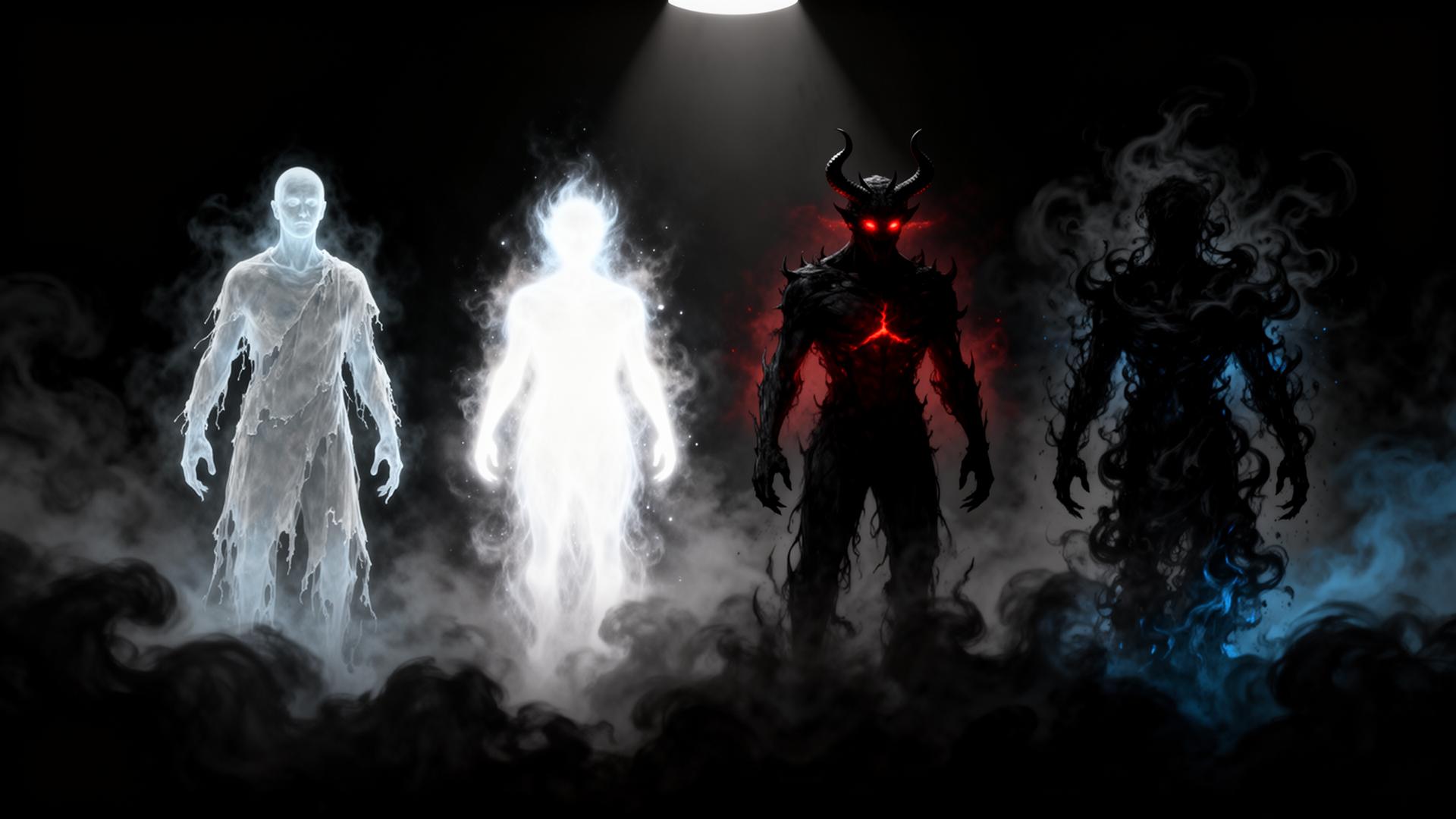
Four words. Most of the public uses them interchangeably. Most of the field does not — because the word you pick determines what you bring, who you call, and what you are willing to risk in the room. What follows is not theology. It is the working vocabulary investigators actually use when they sit down to write a case file.
Each of the four categories below has a different origin, a different relationship to the living, and a different set of signs that tend to cluster around it. Get them confused and you will misread a benign residual as a malevolent presence — or, far more dangerous, the reverse.
I. Ghosts — The Unfinished
1. What 'ghost' actually means
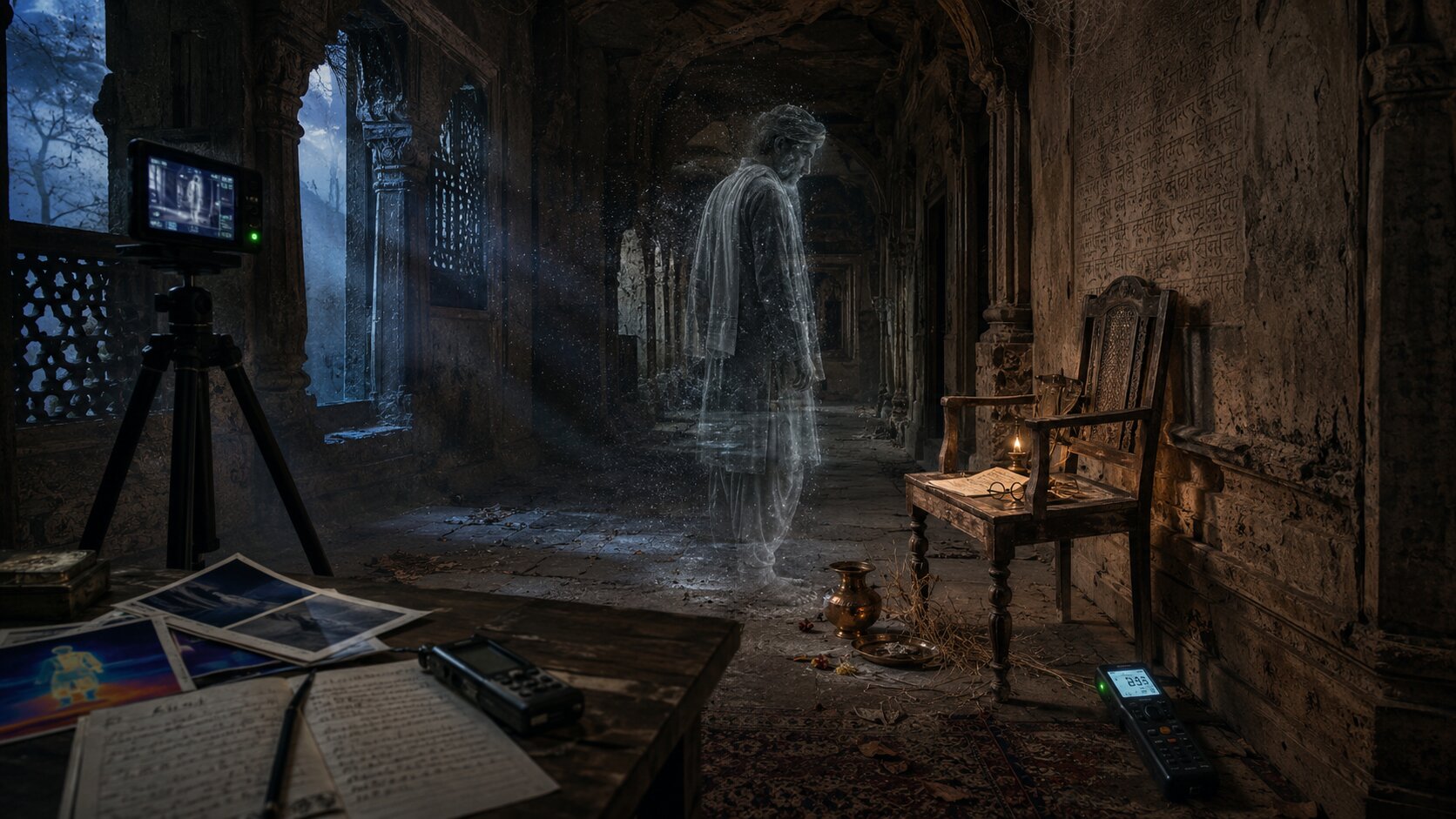
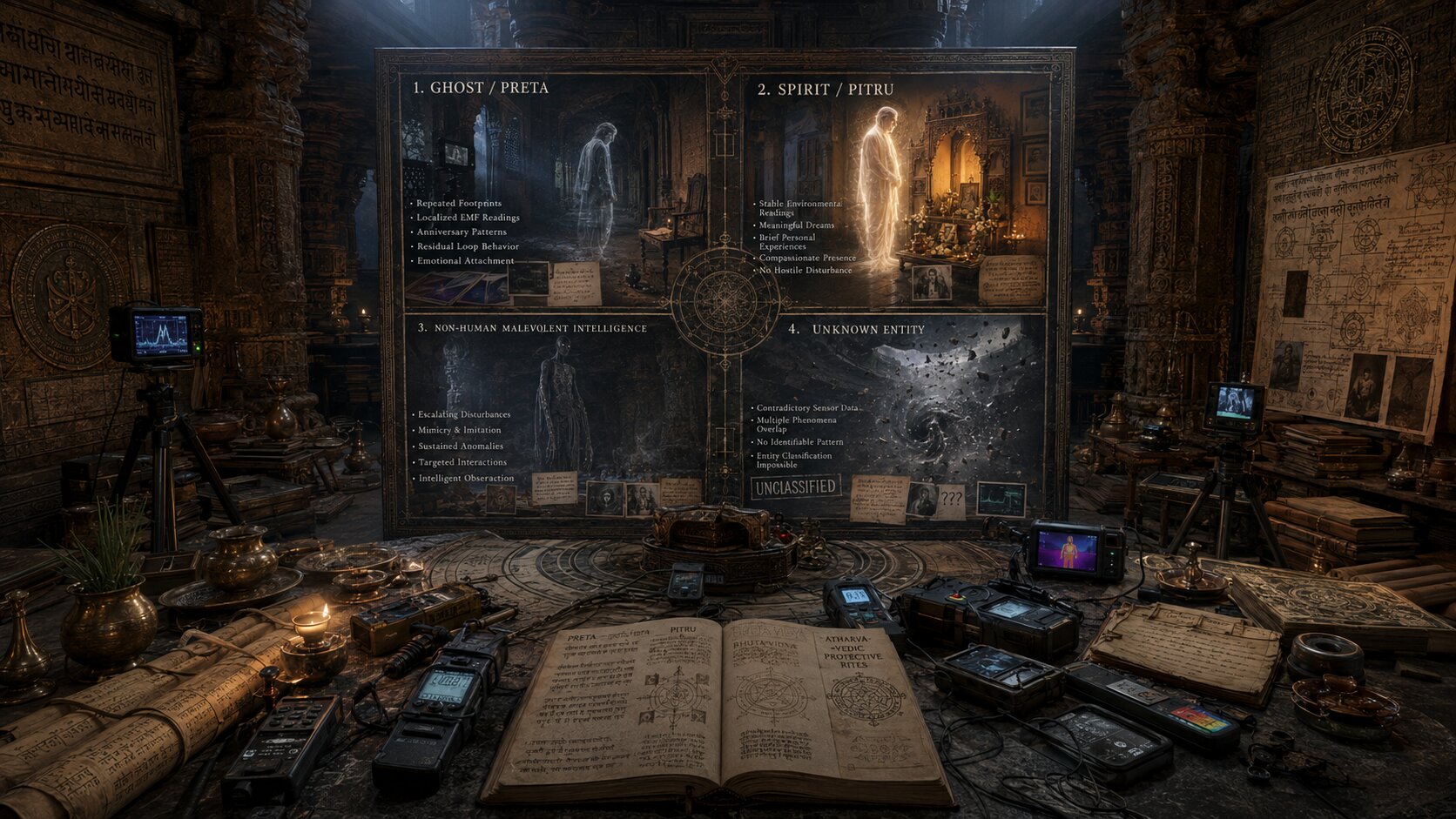
A ghost, in the working sense, is the trace of a once-living human being that has not finished leaving. The death happened. The departure did not. Something — an unresolved attachment, a sudden death, a place too saturated in personal history — keeps a fragment of that person tethered to a physical location or object. Ghosts are, almost by definition, geographically pinned. They walk the same hallway, sit in the same chair, appear at the same window. The pattern is the giveaway.
2. Why a ghost stays
The traditions disagree on the cause but converge on the shape. Hindu funerary texts speak of pretas — souls whose rites were incomplete, who linger in the in-between for years. European folklore points to unfinished business: a debt, a child, a confession never delivered. Modern field experience adds a third category: deaths so violent or so abrupt that the imprint outlasts the person, replaying on its own loop with no awareness of the room around it. This last category is what investigators call a residual haunting — closer to a recording than a presence.
3. How a ghost behaves on site
Ghost activity tends to be repetitive, location-bound, and emotionally legible. Footsteps on the same stair. A door that opens at the same hour. A figure seen in profile, never head-on. The mood the witnesses describe is usually sadness, confusion, or grief — rarely malice. The instruments cooperate: temperature drops are gentle, EMF spikes are local, and the activity reduces sharply when the triggering anniversary passes. A ghost is, more often than not, the easiest of the four to live with once it is correctly named.
II. Spirits — The Finished
4. The difference one word makes
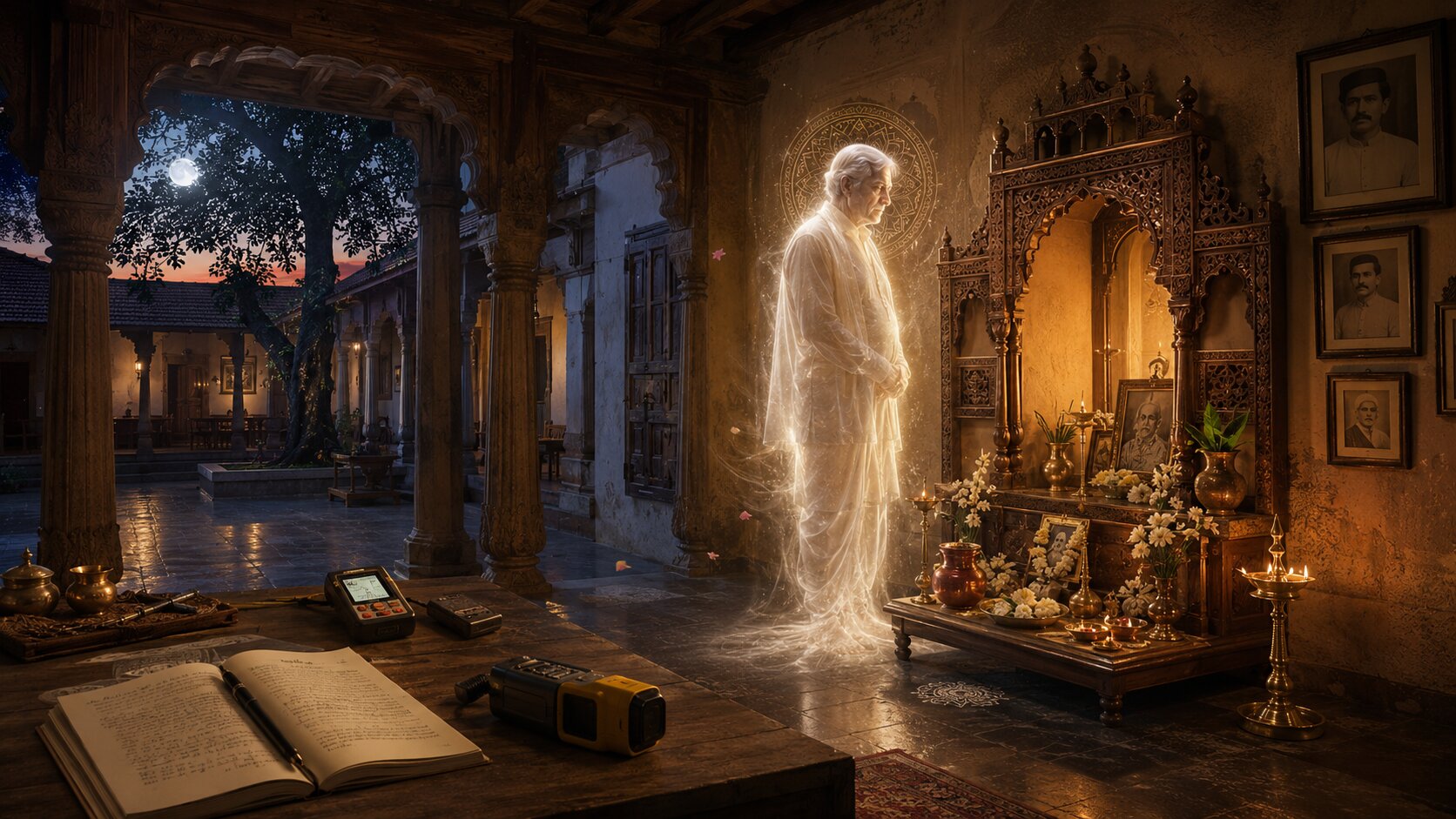
A spirit, in the same working vocabulary, is what a ghost becomes when it finishes leaving. The departure is complete. What remains — and what occasionally returns — is no longer pinned to the floorboards. Spirits are unbound. They visit; they do not haunt. The visit is usually short, often timed to a moment of need on the living side: a grandmother who appears in a dream the night her grandchild is in surgery, a father whose voice arrives in the kitchen the morning of a difficult decision.
5. Spirits in folk and scriptural traditions
Most major traditions reserve a separate word for the finished dead. Sanskrit distinguishes preta (the unfinished) from pitru (the ancestor, released and remembered). Catholic practice prays for the souls in purgatory but venerates the saints. Across the spectrum the structure is the same: one word for the soul that is still working something out, another for the soul that has moved through. Investigators borrow the structure because it maps cleanly onto what witnesses actually describe.
6. Why spirit cases look 'calm' on instruments
Because a spirit is not attached to the site, the physical readings are usually unremarkable. No sustained EMF, no temperature anomalies, no triggered electronics. What the witness reports is almost entirely experiential: a sense of presence, a familiar scent, a dream that did not feel like a dream. Spirit cases are the ones that get closed quickly because there is, in the strictest field sense, nothing to investigate. The visit was the case.
III. Demons — Never Human
7. The non-human category
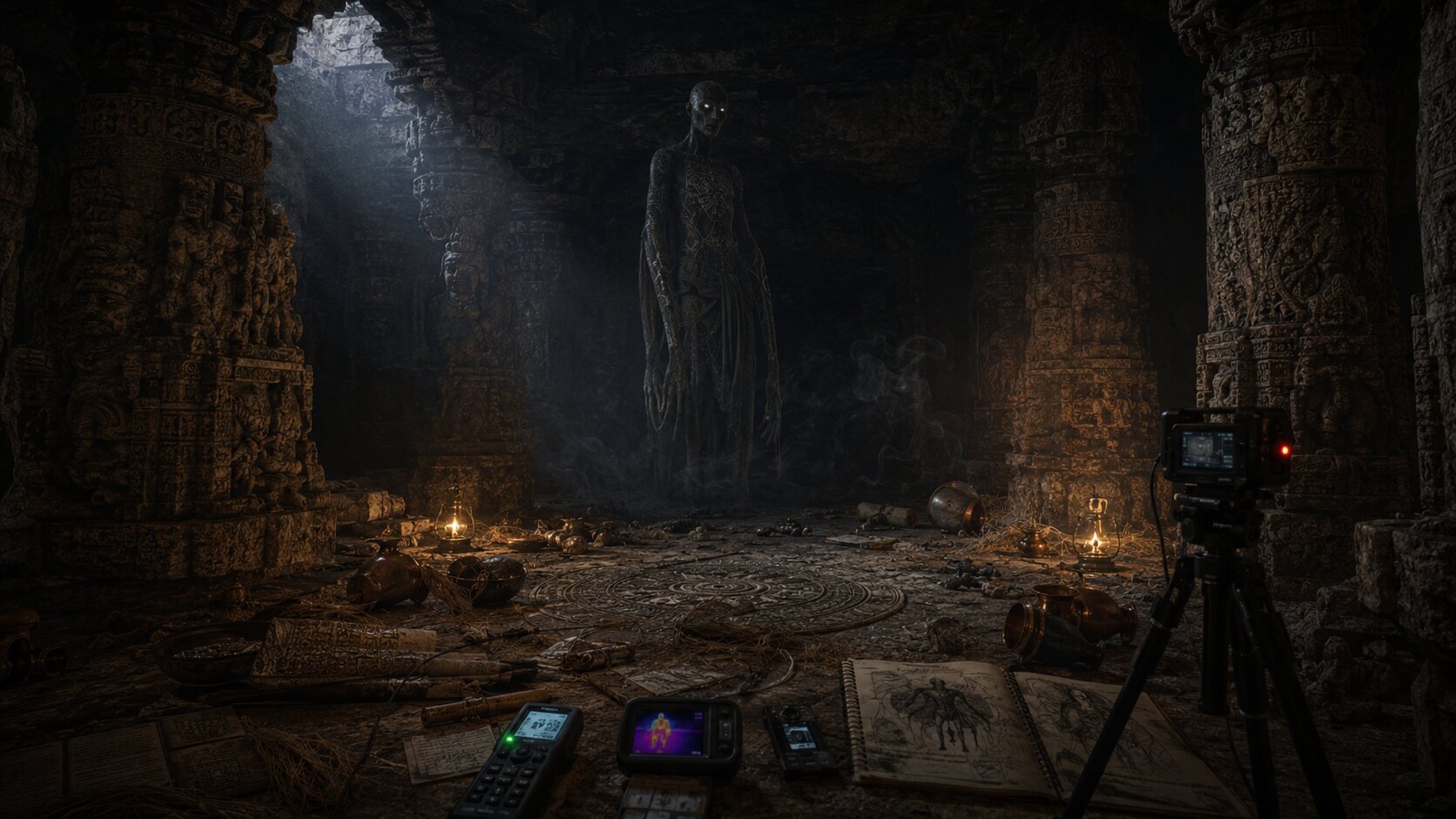
A demon, in this vocabulary, is anything that was never a person. It does not have a death-date because it never had a birth-date. Every major tradition has a word for this category: asura and rakshasa in the Indic texts, daimon and shedim in the Mediterranean and Levantine traditions, the explicitly named demonic hierarchies of Christian demonology. The point is not whether all of these refer to the same thing — they do not. The point is that every tradition recognised a category of intelligence that did not originate as a human soul and built a separate word for it.
8. Markers investigators look for
The clusters that suggest a non-human presence are remarkably consistent across cultures and case files: activity that escalates rather than fades, targeting that follows the person rather than the room, intelligent responses to attempted protections (mockery, mimicry, retaliation), the so-called 'three knocks' pattern, foul odours with no source, and a hostility that feels purposeful rather than confused. Witnesses describe being studied. That word — studied — comes up so often it is now part of the intake checklist.
9. Why mislabeling here is dangerous
Mislabel a ghost as a demon and you frighten a family unnecessarily, sometimes for years. Mislabel a demon as a ghost and you send people back into a room with a smile and a candle, telling them it is just a sad old soul. The first mistake costs sleep. The second can cost more. The conservative move, when the markers are mixed, is to refuse to label at all — which is exactly what the fourth word exists for.
IV. Entities — The Honest Unknown
10. When to say 'entity' instead
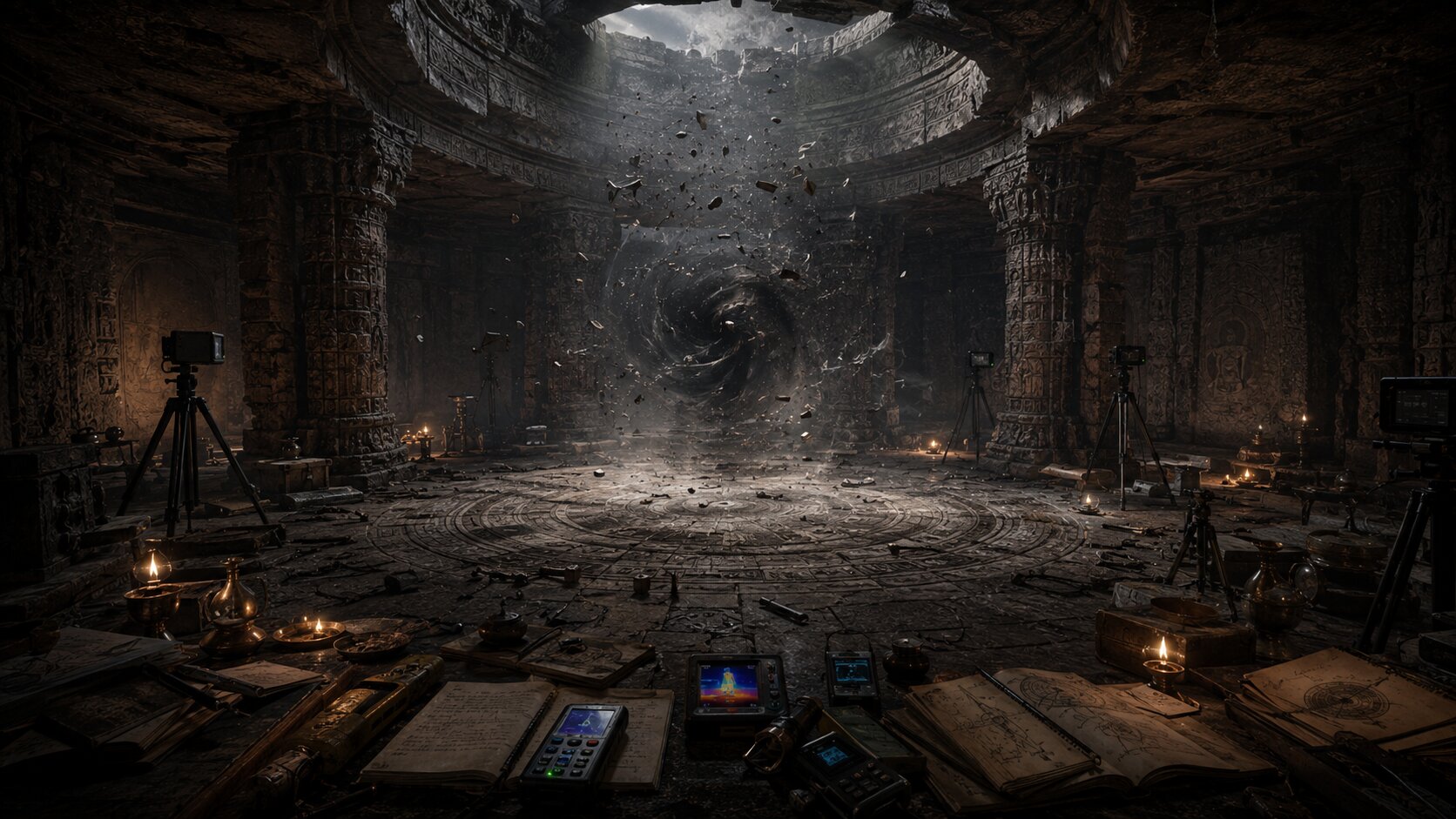
'Entity' is the word investigators reach for when the case will not commit. The activity is real, the witnesses are credible, the instruments are responding — but the pattern does not match ghost, spirit, or demon cleanly enough to write any of those words in the file. 'Entity' preserves the observation without forcing a category. It is a placeholder that says, in effect: something is here, we have ruled out the boring explanations, and we are not yet willing to lie about what it is. A good case file uses the word freely. A bad one tries to dress every encounter as something it can name.
V. Field Triage
11. How investigators actually pick the word
On the ground, the triage is mostly a process of elimination. Is the activity location-bound and repetitive? Likely ghost. Is it a brief, non-recurring visit experienced by one person and tied to a personal moment? Likely spirit. Is the activity escalating, intelligent, and targeting the witness rather than the site? Likely demonic-category, and the case escalates accordingly. Does the evidence resist all three frames? It stays an entity case until something shifts.
| Category | Origin | Behavior | Typical signs |
|---|---|---|---|
| Ghost | Was human, has not finished leaving | Location-bound, repetitive, emotionally legible | Repeating footsteps, anniversary timing, soft EMF, mood of grief |
| Spirit | Was human, has finished leaving | Brief, unbound, visits rather than haunts | Dream visitations, familiar scent, no sustained instrument reading |
| Demon | Was never human | Targets the person, escalates, mocks protections | Sustained hostility, mimicry, foul odour, three-knock patterns |
| Entity | Unknown — by choice | Mixed markers, refuses easy classification | Real evidence, no clean match to the other three |
Why the Vocabulary Matters
These four words are not a hierarchy and they are not a doctrine. They are a working vocabulary that lets two investigators, in two cities, with two different traditions behind them, write the same case file and mean the same thing. The categories will not save you from a bad night in a real room. But picking the right word, in the right file, is the first piece of work that everything else depends on. Get the vocabulary right and the rest of the work gets honest.